
Meditation Garden
Dec 19, 2025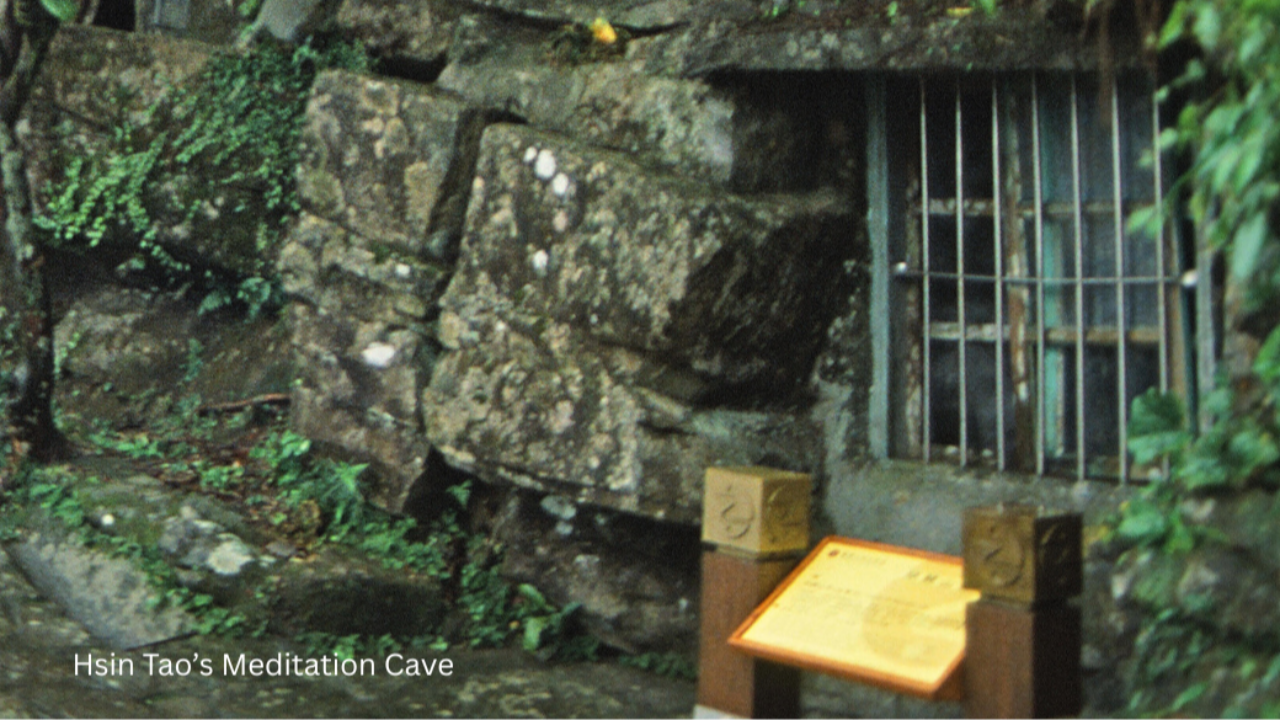
I enter the forest and begin ascending the steep gorge that cuts into the mountainside. Climbing slowly, savoring each breath, I traverse the contours of the trail as it winds above the treetops, past cataracts and along cliffs falling into the aquamarine kelp beds of the Pacific Ocean. The canyon’s lengthening shadows, like a green mantle draped across its rocky bones, slowly enfold me. My mind returns again, as it often does, to Ling Jiao Mountain, and my conversations with the Dharma Master Hsin Tao.
“You have told your disciples that when you were practicing meditation in the cave, you reached a state of deep tranquility where you perceived the unity between your body and the universe.”
Shih Fu nodded, relaxing on his carved wooden dragon throne.
“There are very few people who have gone as deeply as you have into this internal consciousness,” I continued. “What was that experience like?”
How slowly, yet generously, this canyon reveals its secrets. My path leads into the upper recesses of the coastal mountains’ higher groves and ridges, where many wonders are hidden. The environment changes continuously with every step, bringing a new view, every passing fragrance a new mood. Above, the trees are full of wondrously woven webs, invisible until struck by the last rays of afternoon sun; suddenly, rainbow-streaked silver strands wave softly in the branches.
“In the Buddhist view, the attachment to one’s self is the major obstacle to be overcome,” Hsin Tao answered. “This is unique among religions. If there is an ego, then this concept of self breeds monotheism, pantheism, or atheism. Removing this ego attachment is one of the major Dharma practices.
“To do this, you must analyze and dissect yourself. We are a combination of mind and body. Am I the body, or am I the mind? What is the mind? Is the mind the heart, or is there some other mind besides the heart? If the heart is the house of the mind, then what is the mind? Is the body the soul, is the soul the body, or are they separate? Is the soul consciousness or non-consciousness?”
The Master stopped, as if he had answered my question.
The resident bird tribes know of my presence and introduce themselves in their own time. Shifting patterns of light reveal first the depths of the creeks and streams, then gradually their skin, like molten glass sliding over stone. Caves lie concealed in shady crevices, yet always in a place that can be intuited by patterns in rock formations and intangibly subtle scents.
I walk slowly, gazing deeply, tasting the canyon’s breath; its soft whispers invite me into contemplation’s tranquil sanctum.
I waited for clarification, then seeing that Shih Fu was finished, said “But this doesn’t answer my question about your experience of deep tranquility in the cave.”
“I have answered it by describing the analysis of ‘who am I?’ and ‘what is mind?’ he replied. “You should try to find the answer by yourself, then come back and confirm it. In this way, the answer is the genuine answer.”
It seemed like the end of the discussion. I contemplated what Hsin Tao had said, and the directness with which he had simply instructed me to seek my own enlightenment. A moment later he went on, seeing my thoughts.
“I emphasize the importance of the meditative process,” he said. “The same way you study chemistry or physics, each step is integral to the final discovery. I did this all the way. I did not become one with the universe suddenly. I tried to analyze the mind, and ‘me,’ and consciousness, and all these concepts and issues, and gradually I reached oneness with the universe by eliminating the ego.”
I considered his words, trying to understand how the mind projects a sense of self that separates us from totality.
It is early evening when I come to my favorite meditation garden, nestled among the mountain’s pools, boulders, and lush vegetation. In this wild sanctuary far from people, my spirit is bathed in the soft music of twilight, my mind refreshed with the purity of the sweet air, and my heart lifted to the golden sunlight.
The Master went on.
“After all of the ego’s attachments are discarded then we reach true equanimity where there are no differences, no levels, and God and man are one. There are two major works that we do in this endeavor of getting away from the ego attachments: samatha, meditations on tranquility and emptiness, and vipassana, meditations to gain insight into reality.
“A disciplined life gives you a boundary. For example, when I meditated in the cave, the cave became the physical boundary. This is an external discipline. We also have another discipline, internal discipline of the mind. Discipline of the mind involves detaching from things outside us.”
The Master paused, then clarified his earlier statement.
“Actually, the mind itself does not have ego attachment. It is because we become attached that ego appears, but the mind itself has no attachment. If you return to your original mind then there is no self. That original mind does not belong to anything.”
I sit at ease among the perfectly patterned chaos of the streambed’s terrain. Once again, the omnipresent yet perpetually forgotten unity of body and nature reveals itself. My bones are the smooth stones and granite meditation seat. My blood, like a water garden circulating within the landscape of the body, is another tributary of the soft cascades and bubbling pools around me. The warmth in my cells is the setting sun dancing in gold, green, and blue across the sky and vegetation. The breezes swirl among the trees, as my breath absorbs and releases their sweet aromas.
We are threads of memories woven into time and space, cascades of water coursing through conduits of flesh, sparkling drops of sunlight. Seeing how nature’s beneficent intelligence is the fabric of my being, my mind becomes relaxed and spacious.
“What is attachment?” Hsin Tao continued. “All our points of view are attachments. How many points of view do you have? As many points of view that you have, that many attachments you have. Removing your points of view is the key to eliminating the ego’s attachments.
“When I was in the cave I dealt with all of my points of view. At last I asked ‘Since I am not any point of view, then what am I?’”
The Master sat back on his dragon throne. “This is my answer. Are you satisfied?”
Outside, the night is approaching; inside, thoughts gradually subside into tranquility. The stream murmurs, a canyon wren calls.
Slowly, inner and outer melt together until indistinguishable. From nowhere, joy arises without cause; there is only this moment of beatific quietude and exquisite timelessness. Here is the goal, realized, the work fulfilled, the journey completed: the infinite pristine expanse of the heart resting peacefully in the universal Presence that gently holds the world.
Soon, dreams would come, then sunrise, and I would become normal again. The journey would resume, the goal would once more appear distant.
“Is this insight only possible through intensive ascetic practice, or is this something that ordinary people can accomplish in daily life?” I asked the Dharma Master.
“My ascetic practice is an old traditional way,” he replied. “But do we have to do this in the traditional way? You don’t have to do it in the old way to eliminate ego attachments. Maybe we can do this anytime. We try to look for places where good conditions are met. I found that a cave was the best place, and a graveyard was even better. Otherwise we have desires, friends, all kinds of relationships, problems in our lives. You may not be able to face all these problems and also remove ego attachments.”
“The endeavor requires hard work and expertise,” Hsin Tao concluded. “It takes a lot of time to reach that state. We may know this, but we are not able to actualize it. I spent a lot of time doing this, and I was lucky to have so much time. It is not easy to have so much time doing that; we have to eat, we get sick, and there will be a lot of disturbances. But during that time I did not meet with those obstacles, and was able to do that work.”
I wake to chanting – a trio of owls greeting the moon as she rises above the mountain. While I slept, the forest was transformed into a phantasmagoria of gnarled shapes, black against silver. Pairs of glinting nocturnal eyes move about, insects scratch under the floor of oak leaves and moss. Like a curtain parting, swirling mists open on the Milky Way, streaked with silent meteoric phosphorous. The trees sigh with the wind’s caress, as the owls sing their simple melody.


